
The term “5G” frequently appears in discussions about modern technology, from concerns over foreign governments accessing wireless networks to the advent of autonomous cars. In this article, we will explore what 5G is, its hype, and its current reality in 2024.
What is a “G”?
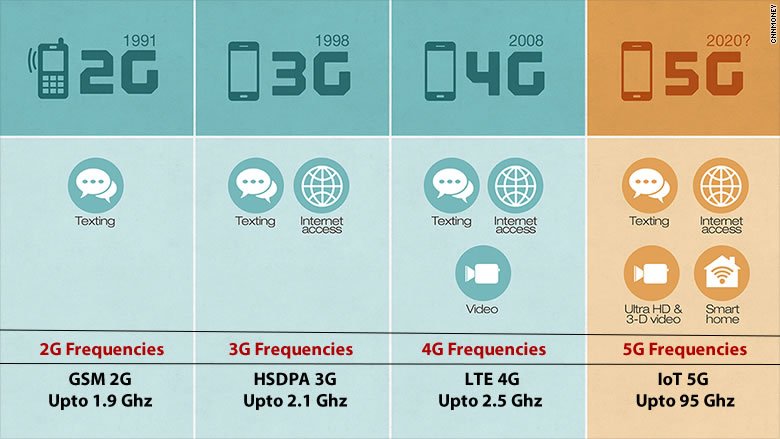
“G” stands for “Generation” of Cellular Technology. The first generation, 1G, provided only analog radio signals for voice communication. For more on the history of 1G, you can refer to this article.

1 G Phones
In 1991, 2G was introduced, allowing voice transmissions to go digital and enabling text messaging. This shift to digital transmission enhanced security, as analog signals could be easily intercepted.
With the arrival of 3G in 1998, slow internet connectivity became available, mainly through WAP browsers at data speeds of 2 Mbps. Since 2008, 4G (also known as LTE) has offered data speeds ranging from 10 to 100 Mbps, making video streaming possible.
After a decade of 4G, 5G is now emerging, promising data speeds starting at 2 Gbps and potentially reaching 100 Gbps. To put this in perspective, 5G’s top speed is 1,000 times faster than 4G’s maximum speed of 100 Mbps. Another significant advancement with 5G is the reduction in lag time, enhancing real-time communication and interaction.
Breaking Down the Waves
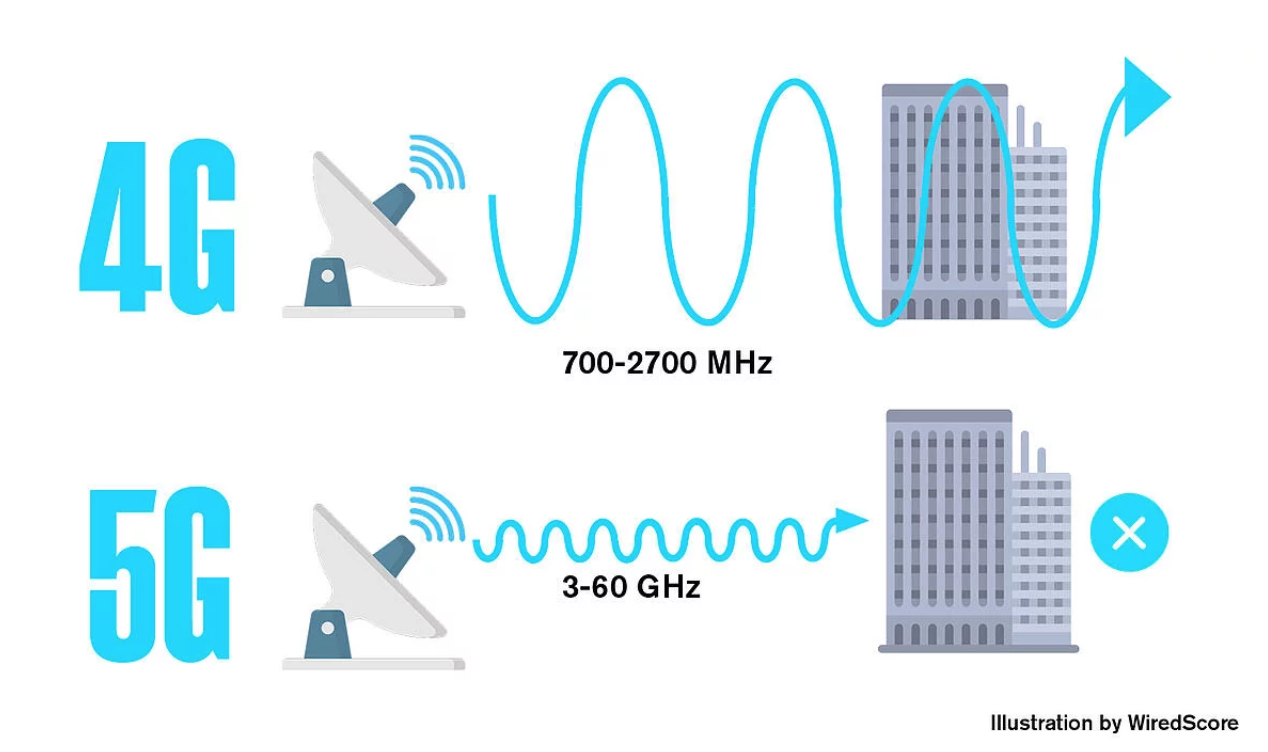
The microwaves that connect our mobile devices in 4G and 5G differ in wavelength, affecting their speed and strength. An analogy to understand this is to think of a surfer:
- 4G: Larger waves with big gaps between them, starting far out in the ocean, bringing a few surfers to the beach every few minutes. These waves cover larger areas (up to 72 km or 45 miles from a tower) and can penetrate obstacles like buildings but provide slower data speeds.
- 5G: Smaller waves with small gaps between them, appearing closer to the beach, unable to flow over rocks or sandbars but bringing many surfers to the beach quickly. These waves cover smaller areas (around 250 meters or 850 feet from the tower), struggle to penetrate obstacles, and even have issues with rain but deliver data at much higher speeds.
Beyond the Wave
The limited coverage of 5G is mitigated by its smaller antennas, allowing base stations to be placed on light and power poles. These base stations are more powerful and compact, with hundreds of ports compared to 4G’s 12, enabling them to serve more devices.
After the Wave
The increased data capacity of 5G requires substantial infrastructure investment, particularly in fiber optic wiring, known as “backhaul.” Experts predict that meeting 5G’s demands could necessitate an 80% to 100% increase in the existing fiber optic network, with telecom companies potentially doubling their infrastructure investment between 2020 and 2025.
Conclusion
When we look at where 5G is today compared to where we thought we’d be five years ago, there’s a big difference in how it’s being used. New uses for 5G and its adoption has been slow, which is what we expected. Telecom companies’ revenues have stayed mostly the same, which was also expected. However, the switch from 4G to 5G for mobile broadband and fixed wireless access has been faster than we and the industry predicted.
In conclusion, too much hype can lead to disappointment and overly optimistic predictions, especially if the main players have different expectations. Before we call 5G a success or failure as it turns five, we should remember that it took 10 years for enterprise Wi-Fi to reach 10% of its projected 2027 level. We tend to overestimate the effect of a technology in the short run and underestimate it in the long run. So, it’s still early days for 5G.